


How Do Smart Sensors Work?

Smart sensors help devices detect their surroundings, process information and respond automatically. They are used in smart lighting, irrigation, security systems and industrial monitoring.
1. What Is a Sensor?
A sensor detects a physical condition and converts it into a signal an electronic system can understand. Sensors can measure temperature, light, motion, distance, humidity, gas, pressure, sound and soil moisture.
Explore beginner-friendly modules in the IBOTS 37-in-1 Sensor Kit.
2. What Makes a Sensor Smart?
A basic sensor detects and produces a signal. A smart sensor system can also combine sensing with processing, communication or decision-making.
Physical Environment → Sensor → Microcontroller → Data Processing → Decision → Action
Example: a soil-moisture sensor detects dry soil. The microcontroller processes the reading and activates a pump when watering is needed.
For hands-on automation projects, see the IBOTS Internet of Things Kit.
3. How Does a Smart Sensor System Work?
Sensing: The sensor detects a condition.
Data conversion: The measurement becomes an electrical signal.
Processing: A microcontroller reads and processes the signal.
Decision: The system checks the reading against a programmed condition.
Action: It displays information, sends an alert or activates a device.
Example: Temperature sensor → ESP32 → if temperature exceeds 35°C, switch on a fan.
The IBOTS Embedded Kit supports sensor interfacing and microcontroller projects.
4. Basic Sensor vs Smart Sensor
| Feature | Basic sensor | Smart sensor system |
| Sensing | Yes | Yes |
| Signal output | Yes | Yes |
| Data processing | Usually external | Can be integrated |
| Communication | Often limited | May support connectivity |
| Automation | Needs a controller | Can be part of a system |
A smart sensor does not necessarily contain an AI processor; the term can describe a system combining sensing with processing or communication.
5. Analog and Digital Sensors
Analog sensors: produce continuously varying signals. A microcontroller reads the voltage through an Analog-to-Digital Converter (ADC).
Digital sensors: provide digital output or communicate through interfaces such as I²C, SPI, UART or one-wire.
Beginners can explore modules with the IBOTS Official Arduino Sensor Kit.
6. Common Smart Sensors
Temperature sensor: Monitors temperature in homes, weather systems and equipment.
PIR motion sensor: Detects movement for security systems and automatic lights.
LDR light sensor: Detects light changes for automatic lighting.
Ultrasonic sensor: Measures distance for obstacle detection and parking assistance.
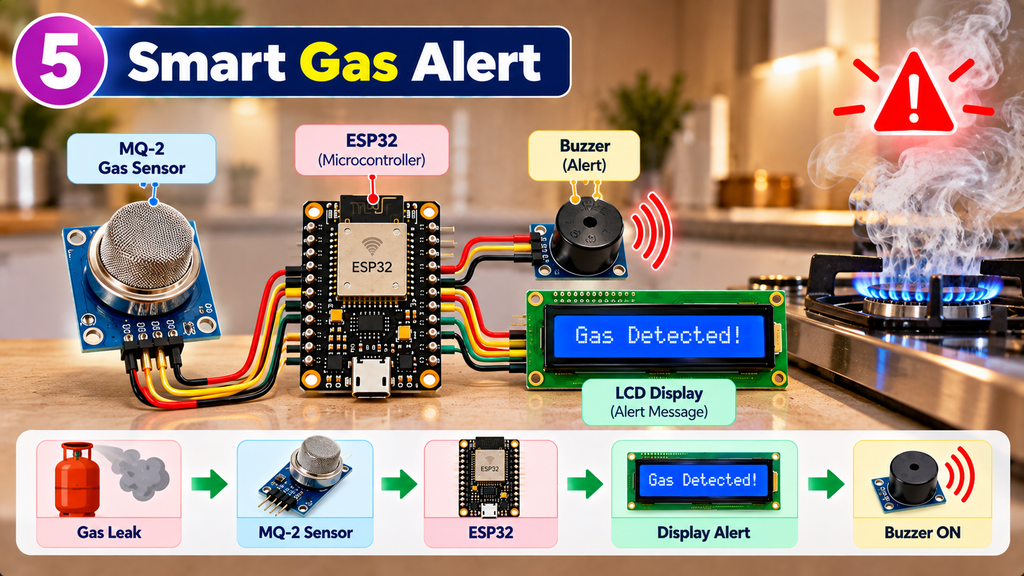
MQ-2 gas sensor: Detects changes in certain gas concentrations and can trigger an alert.
Soil-moisture sensor: Measures soil moisture for irrigation systems.
7. ESP32 and IoT
The ESP32 supports processing, Wi-Fi and Bluetooth, making it useful for connected sensor projects. A typical setup is Sensor → ESP32 → Wi-Fi → mobile app, cloud service or dashboard.
Explore the IBOTS ESP32 Development Board.
8. Beginner Project Ideas
Automatic street light: LDR → microcontroller → LED | Explore the IBOTS 37-in-1 Sensor Kit

Temperature monitor: Temperature sensor → ESP32 → display | Explore the IBOTS ESP32 Development Board

Smart irrigation: Soil-moisture sensor → controller → relay → pump | Explore the IBOTS Soil Moisture Sensor Module

Parking assistance: Ultrasonic sensor → ESP32 → distance display | Explore the IBOTS Internet of Things Kit

Gas alert: MQ-2 → controller → buzzer | Explore the IBOTS IoT Kit for sensor projects
Conclusion
Sensors measure changes in the physical world. Combined with microcontrollers, connectivity and automation, they can help systems monitor conditions and take useful actions. Learning sensor fundamentals is a practical starting point for embedded systems and IoT.
Explore