
Edge AI Explained: How Artificial Intelligence Is Moving from the Cloud to Small Devices

What Is Edge AI? How Artificial Intelligence Is Moving to Small Devices

Artificial Intelligence is no longer limited to powerful computers and cloud servers.
Today, AI can run on surprisingly small devices.
A camera can detect an object.
A sensor can identify an unusual pattern.
A wearable device can process information locally.
A smart device can make a decision without continuously sending raw data to a remote server.
This shift is known as Edge AI.
But what exactly is Edge AI?
How is it different from traditional cloud-based AI?
What is TinyML?
And how can beginners start learning this technology?
Let’s break it down from the fundamentals.
What Is Artificial Intelligence?
Before understanding Edge AI, let’s quickly understand AI.
Artificial Intelligence (AI) refers to computer systems designed to perform tasks that normally require some form of human intelligence.
These can include:
- Recognizing objects
- Understanding speech
- Detecting patterns
- Classifying information
- Making predictions
- Identifying unusual behavior
- Making decisions based on data
For example, imagine a camera looking at an image.
A traditional program might follow rules such as:
If pixel brightness is greater than X, perform Y.
An AI model can instead learn patterns from examples.
For instance:
Training images
→ Dog
→ Dog
→ Dog
→ Cat
→ Cat
→ Cat
The model learns patterns that help it distinguish between the two categories.
That basic idea leads us toward machine learning.
What Is Machine Learning?
Machine Learning (ML) is a branch of AI where systems learn patterns from data rather than relying entirely on manually written rules.
A simplified ML workflow looks like this:
Data
↓
Training
↓
Machine Learning Model
↓
Prediction
For example, suppose we want to detect whether a machine is operating normally.
We could collect:
- Temperature
- Vibration
- Sound
- Current consumption
The model can learn patterns associated with normal and abnormal conditions.
Later, when new sensor data arrives, the model can make a prediction.
This is where things become interesting for IoT.
Traditional IoT vs AI-Powered IoT

Traditional IoT vs Edge Computing
Traditional IoT usually follows this flow:
Sensor → Microcontroller → Internet → Cloud → Processing → Result
For example, a temperature sensor sends its readings to the cloud, where the data is processed and the result is returned.
This works well, but it can become a problem when fast decisions, low latency, limited internet, or reduced data transmission are important.
That’s where Edge Computing comes in.
What Is Edge Computing?
Edge computing means processing data closer to where it is generated, instead of sending everything to a remote cloud server.
For example:
Traditional:
Camera → Internet → Cloud → AI → Result
Edge:
Camera → Local AI → Result
The device can process the information locally and send only important results to the cloud.
What Is Edge AI?
Edge Computing + AI = Edge AI
Edge AI means running AI or machine-learning models directly on or near the device collecting the data.
It can be used in:
- Smart cameras
- Robots
- IoT devices
- Wearables
- Industrial systems
- Embedded devices
- Microcontrollers
The advantage is that devices can make faster, local decisions without depending completely on the cloud.
What Is TinyML?
TinyML (Tiny Machine Learning) focuses on running machine-learning models on small, low-power devices such as microcontrollers.
Traditional ML
Sensor → Cloud/Computer → ML Model → Result
TinyML
Sensor → Microcontroller → ML Model → Result
This allows small devices to become more intelligent without requiring a powerful computer.
How Does Edge AI Work?
A simple Edge AI workflow is:
1. Collect Data
Sensors or cameras collect information.
↓
2. Prepare Data
The data is cleaned and formatted.
↓
3. Train Model
A machine-learning model learns from sample data.
↓
4. Optimize & Deploy
The model is optimized and placed on the edge device.
↓
5. Inference
The device analyzes new data and makes a prediction locally.
Training vs Inference
Training: The model learns from data.
Inference: The trained model makes predictions from new data.
Edge AI mainly focuses on local inference.
A Simple Example
Consider a smart plant-monitoring system.
A basic IoT system might simply measure:
Soil Moisture = 35%
A rule-based system could say:
If moisture is below 30%, turn on the pump.
An AI-based system can consider multiple factors such as:
- Soil moisture
- Temperature
- Humidity
- Light
- Previous readings
The model can then make a more intelligent prediction locally.
Where Is Edge AI Used?
Smart Cameras
Object detection, person detection and event recognition.
Robotics
Processing camera and sensor data for quick decisions.
Industrial Monitoring
Detecting unusual vibration, temperature or motor behavior.
Smart Homes
Occupancy detection, automation and energy management.
Wearables
Processing sensor data locally for faster responses.
Edge AI + IoT
This is where things get really interesting.
IoT provides:
Sensors + Connectivity
AI provides:
Pattern Recognition + Decision Making
Edge Computing provides:
Local Processing
Together, they create intelligent connected devices.
Simple Architecture
Sensor → Microcontroller → AI Model → Local Decision → Action → Optional Cloud
Instead of sending every piece of raw data to the cloud, the device can analyze the data locally and act immediately.
Learn Edge AI with an IBOTS Tiny ML Kit
This is where the concept can move from theory to practical learning.
The IBOTS Tiny ML Kit is designed specifically around the idea of bringing machine learning to the edge. According to IBOTS, the kit introduces learners to AI and machine learning, ML models on microcontrollers, sensor-based intelligent decision-making and Edge AI concepts. (IBOTS)
The kit includes:
- ESP32-CAM modules
- ESP32-CAM programmer
- CP2102 USB-to-TTL converter
- ESP32 development board
- ESP programming cable
- 16×2 I2C LCD
- 5V buzzer
- Jumper wires (IBOTS)
Explore the IBOTS Tiny ML Kit
This makes it possible for learners to move beyond simply asking:
“What is AI?”
and start exploring:
“How can AI run on a small device?”
What Is an ESP32 Doing in Edge AI?
The ESP32 family has become popular in IoT development because many variants combine processing capabilities with wireless connectivity.
For example, IBOTS lists ESP32 development boards supporting Wi-Fi and Bluetooth, along with interfaces such as GPIO, ADC, DAC, SPI and I2C. (IBOTS)
This combination is useful for prototyping connected intelligent devices.
A simplified architecture could look like:
Camera / Sensor
↓
ESP32
↓
ML Model
↓
Prediction
↓
Action / Display
↓
Wi-Fi / Bluetooth
The exact capabilities depend on the ESP32 variant and the model being deployed.
Edge AI Doesn’t Mean “No Cloud”
This is a common misunderstanding.
Edge AI doesn’t necessarily mean the cloud disappears.
A real system may use both edge and cloud computing.
For example:
┌── Local Decision
Sensor → Edge AI ┤
└── Important Data → Cloud
The edge device handles immediate processing.
The cloud can handle:
- Long-term storage
- Analytics
- Model management
- Dashboards
- Large-scale processing
This combination is sometimes called a hybrid edge-cloud architecture.
Edge AI vs Cloud AI: When Should You Use Which?
There isn’t one universal answer.
Edge AI can be useful when:
- Fast response is important
- Internet connectivity is limited
- Local processing is desirable
- Bandwidth is constrained
- A small model can perform the required task
Cloud AI can be useful when:
- Large models are required
- Significant computing power is needed
- Large-scale data processing is required
- Centralized analytics are important
Many real systems can combine both approaches.
Why Should Electronics Students Learn Edge AI?
Electronics is changing.
Earlier, a beginner might learn:
LED → Sensor → Arduino → Motor
That foundation is still important.
But modern embedded systems increasingly combine:
Electronics + Programming + Connectivity + Data + AI
A student who understands both the fundamentals and newer technologies can build a stronger foundation for modern projects.
For example:
Beginner
LDR → Arduino → LED
Intermediate
LDR → ESP32 → Wi-Fi → Dashboard
Advanced
Sensor → ESP32 → ML Model → Intelligent Decision → IoT Platform
The hardware fundamentals haven’t disappeared.
They have simply become part of a larger technology stack.
From Basic Electronics to Edge AI
This is the learning progression I’d recommend:
Level 1 — Electronics Fundamentals
Learn:
- Voltage
- Current
- Resistance
- LEDs
- Resistors
- Sensors
- Motors
↓
Level 2 — Microcontrollers
Learn:
- Arduino
- ESP32
- GPIO
- ADC
- PWM
- I2C
- SPI
↓
Level 3 — IoT
Learn:
- Wi-Fi
- Bluetooth
- MQTT
- APIs
- Cloud dashboards
↓
Level 4 — Machine Learning
Learn:
- Data
- Features
- Training
- Classification
- Inference
↓
Level 5 — Edge AI
Combine:
Microcontroller + Sensors + ML + Local Inference
This progression keeps the fundamentals while introducing modern technology.
5 Beginner-Friendly Edge AI Project Ideas
1. Smart Object Detection
Camera → ESP32-CAM → ML Model → Object classification

Learn:
- Computer vision
- Embedded AI
- Camera processing
2. Intelligent Sound Detection
Microphone → Edge device → ML model → Sound classification

Possible applications include identifying specific sounds or events.
3. Smart Machine Monitoring
Vibration sensor → Microcontroller → ML model → Condition classification

The system could learn patterns associated with different machine states.
4. AI-Based Occupancy Detection
Camera/Sensor → Edge device → Model → Occupancy result
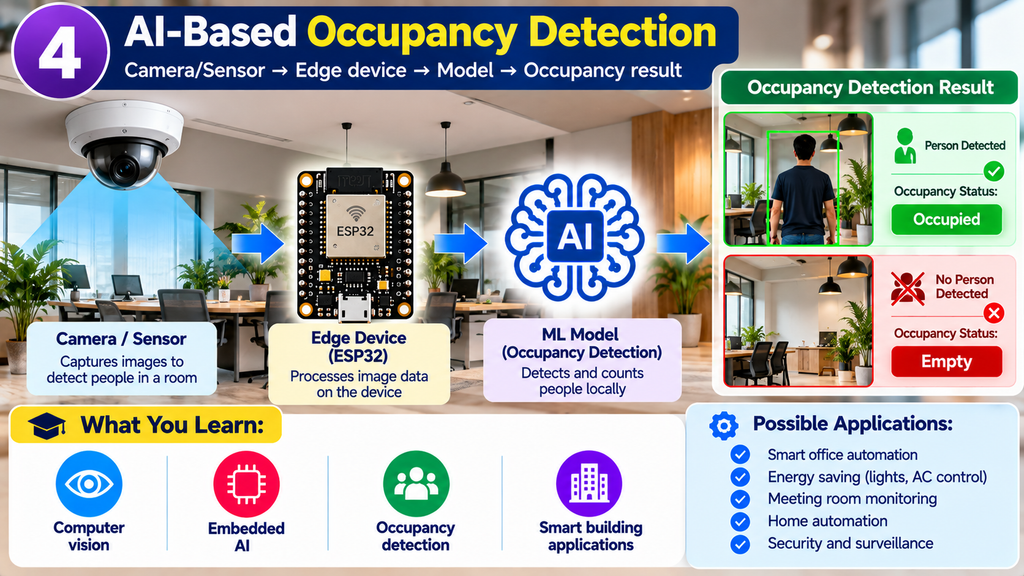
Useful for smart-building concepts.
5. Intelligent IoT Alert System
Sensor → Edge AI → Decision → Buzzer / Display / Wi-Fi

This combines the fundamentals of electronics with modern AI and IoT concepts.
What Skills Do You Need to Learn Edge AI?
You don’t have to learn everything at once.
Start with:
Electronics
- Sensors
- Microcontrollers
- Digital and analog signals
Programming
- C/C++ basics
- Arduino programming
- Python basics
IoT
- Wi-Fi
- MQTT
- APIs
- Cloud concepts
AI/ML
- Dataset
- Features
- Classification
- Training
- Inference
Embedded AI
- Model optimization
- Memory limitations
- Power consumption
- Deployment
This combination creates a useful foundation for working with modern intelligent devices.
The Future: Smaller Devices, Smarter Decisions
One of the interesting directions in technology is that intelligence is increasingly moving closer to the device that generates the data.
Instead of every sensor simply collecting information and sending it somewhere else, devices can increasingly process, interpret and act on information locally.
That doesn’t mean every device needs AI.
It means developers now have another option:
Make the device itself intelligent.
For students and makers, this opens up an exciting path from simple electronics projects to intelligent embedded systems.
Frequently Asked Questions
What is Edge AI?
Edge AI refers to running AI or machine-learning inference on a device near where the data is generated rather than relying entirely on a remote cloud service.
What is TinyML?
TinyML focuses on running machine-learning models on small, resource-constrained devices such as microcontrollers.
Is Edge AI the same as IoT?
No.
IoT focuses on connected devices and data exchange, while Edge AI adds AI-based processing or decision-making at or near the device.
Can ESP32 be used for Edge AI?
Certain ESP32 variants and suitable optimized models can be used for embedded AI and TinyML applications. The exact capability depends on the specific ESP32 variant, memory and model requirements. IBOTS currently offers several ESP32-based development boards and an Edge-AI-focused Tiny ML Kit. (IBOTS)
Does Edge AI require the internet?
Not necessarily. One of the benefits of local inference is that a device can perform certain AI tasks without continuously sending raw data to a cloud service.
Is Edge AI only for professionals?
No. Beginners can start with the fundamentals of electronics, microcontrollers and machine learning before progressing toward TinyML and Edge AI.
Start Learning Modern Technology with IBOTS
Technology is moving from:
Connected devices
to
Connected + Intelligent devices.
The best way to understand that transition is not to skip the basics.
Start with electronics.
Learn microcontrollers.
Understand sensors.
Build IoT projects.
Then add machine learning.
Finally, explore Edge AI.
That gives learners a practical path from fundamentals → IoT → AI → Edge AI.
Learn & Explore Projects
For courses, hands-on learning and technology projects:
Need Help With a Technical Problem?
For technical questions and assistance: